

🔥 Sánchez's Week from Hell
Plus: Gay-jà vu all over again, and Princess Leonor flew a plane with dad!

Madrid | Issue #152
🚨 The Bubble is Spain's #1 English-language newsletter. We offer paid and free subscriptions (which you can customize). Or interested in sponsorship opportunities?Click here to find out how to book a spot.
It’s getting hot in here
💥 “Everything Everywhere All at Once”, Sánchez edition
No, it’s not because of the heat wave. Right now, everything is hitting Prime Minister Pedro Sánchez at once. This week has delivered a brutal one-two-three punch: his former right-hand man, José Luis Ábalos, was sentenced to over 24 years in prison, his ex-adviser Koldo García to nearly 20, and his wife, Begoña Gómez, is now officially heading to trial in a separate case.
Legal Earthquake #1. On Monday, the Supreme Court issued a ruling in the so-called Caso Koldo (which we’ve covered many times here). Ábalos, who was once one of the most powerful figures in Sánchez’s PSOE and a key architect of his rise to power, was found guilty of running a corruption scheme tied to pandemic-era mask contracts (and got the longest prison sentence ever for a former minister — congrats!).
Bad men #1 + #2. The court found he participated in an organized operation involving kickbacks, influence-peddling, and steering public contracts allegedly steered toward friendly companies. His close aide, Koldo García, was also convicted as part of the same network.
SnitchingCooperating pays. Then there’s Víctor de Aldama, the businessman at the center of the scheme, who was convicted too, but won’t go to prison because he cooperated with the authorities. The court explicitly rewarded his testimony and evidence, arguing that collaboration helps dismantle corruption networks.The audacity! Inside the government, that decision has triggered real unease. Not because of Aldama himself (who made threats against Sánchez, suggesting he was involved), but because of what it signaled (at least to them):
tell the truth, and you will receive leniencytestify against the socialist party, and you walk.
Legal Earthquake #2. Just when things couldn’t get more complicated politically, another crisis hit Sánchez’s personal orbit. That is, Judge Juan Carlos Peinado has formally opened trial proceedings against his wife, Begoña Gómez, accusing her of leveraging her position as the prime minister’s wife to boost her professional projects and influence business relationships.
The charges range from influence peddling to corruption in business dealings — serious accusations that Gómez has denied. The Madrid public prosecutor has questioned the solidity of the case, but Peinado is like a dog with a bone and is pressing ahead nonetheless.
Red flags. What has really set off alarm bells, though, is how the judge is handling it. In a WTF moment highly controversial move, he ordered Gómez to surrender her passport and banned her from leaving Spain, citing a potential flight risk.
Questioning the Thin Blue Line. Peinado suggested that the very police officers assigned to protect her could help her escape (which pissed off pretty much everyone). The National Police and police unions, which are not exactly known for siding with this government, called it outrageous. And the judicial watchdog, the CGPJ, voted in favor of opening a disciplinary investigation into the judge over those statements. (Still, Gómez turned in her passport yesterday).
Out to get her? This case itself has been controversial from day one. It originated from what many saw as a flimsy complaint filed by Manos Limpias, a pseudo-union linked to the far right, and has been marked by a series of once again, WTF eyebrow-raising moments.
No comment. Sánchez’s response has been a combination of trolling and exhaustion. Just hours after the Supreme Court’s bombshell ruling on Koldo, he posted a TikTok advising people to drink water and wear sunscreen during the heatwave.
The best defense is a good offense. Yesterday in Parliament, he switched to full mixed metaphor combat mode, condemning corruption, defending his record, and aggressively going after the opposition, especially the PP. Corruption exists, he says, but not in his government as a system (a distinction that may be too cute by half), and certainly not on the scale seen in previous administrations (which sounds like he admits it exists, but anyway…).
The opposition laughed at his response, with PP leader Alberto Núñez Feijóo asking him to call an election. Even former Socialist PM Felipe González said he should either resign or call early elections out of “political responsibility.”
What happens now? We’re headed for a summer break (yay!). Begoña Gómez is on track to stand trial unless a higher court intervenes, and the broader corruption investigations linked to the Caso Koldo are still unfolding, meaning more revelations could be coming.
Sánchez insists he will stay the course until 2027 (though his comments suggest he’s rebating that from July to March). But after a week like this, that timeline suddenly looks far less certain.
More news below. 👇👇
🔔 But first… Don’t miss the latest episode of The Bubble Podcast!
We discuss PM Zapatero’s corruption accusations, the very complicated relationship between the US and Spanish governments, and the World Cup. Find us on Spotify, Apple Podcasts, and YouTube!
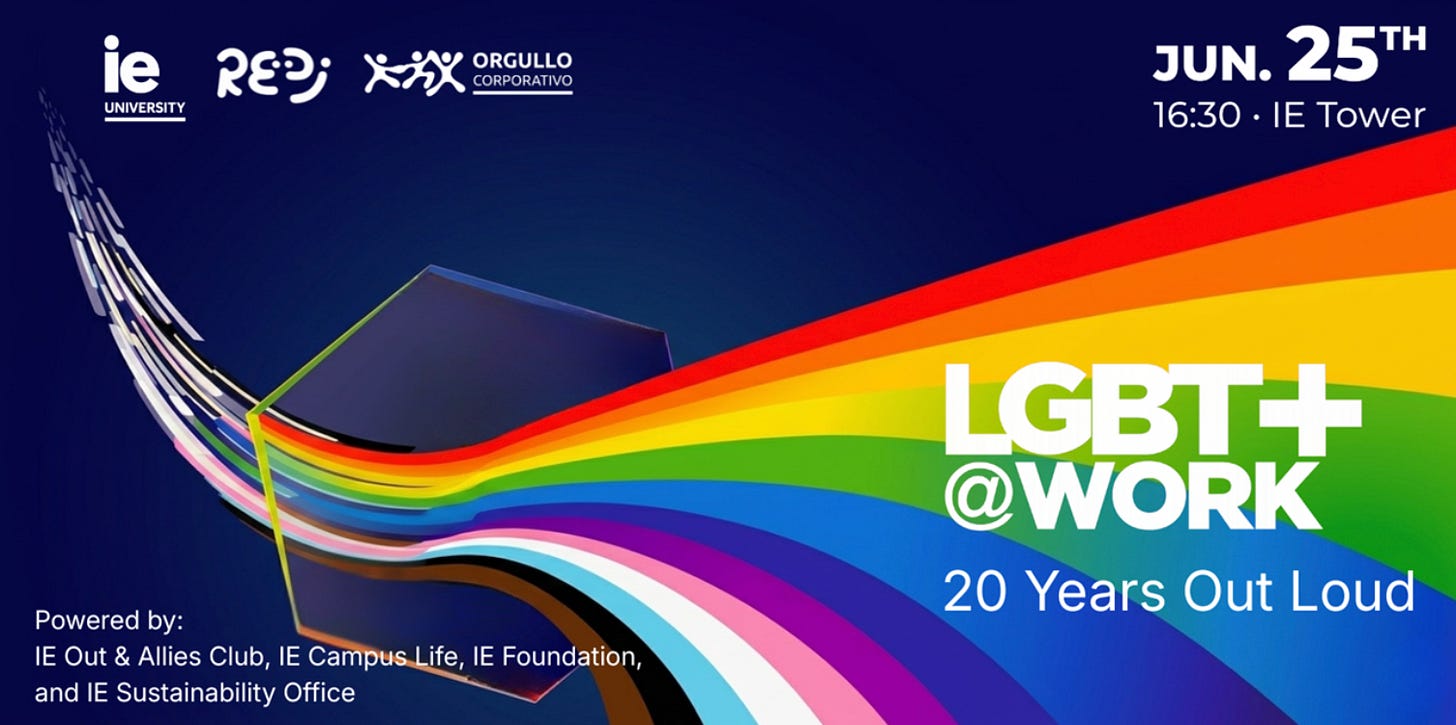
IE University proudly presents the 20th edition of LGBT+@Work, one of the leading LGBTIQ+ conferences in Europe and the longest-running of its kind since its launch in 2006. Two decades later, this flagship event continues to foster meaningful conversations on diversity, equity, and inclusion in the business world.
Register here to attend today!
💬 Five things to discuss at dinner parties
1. 🇺🇸💔🇪🇸 Are American businesses souring on Spain as Sánchez and Trump duke it out?
Economic reverb. Prime Minister Pedro Sánchez’s stand against President Trump’s war in Iran, tech bro assholishness, and Israeli military attacks are either a principled stand against the 🍊 Menace’s policies or the political grandstanding of a leader unloved at home (or both; it can be both). But it could be hitting Spain where it really hurts — you know, el bolsillo 🤑.
What’s the deal? American companies are pulling money out of Spain at a historic pace. Between January and March 2026 — the first quarter to fully capture the diplomatic faceoff between Madrid and Washington — U.S. disinvestment sextupled (not often you get to use that word!), rising 534% year-over-year to €3.3 billion.
Long time high. That’s the largest quarterly disinvestment spike going back to when records began in 1993. Net U.S. investment cratered 719%, flipping from slightly positive a year ago to negative €1.97 billion. In one quarter, ‘merica went from Spain’s #1 foreign investor to #254.
The timing is a bit obvs. Sánchez came out hard in March against the U.S. and Israel’s quest to send Iran back to the Stone Age, including by blocking America from using the joint bases in Spain for the war. Trump responded by calling Spain “a terrible partner.” That’s the last month the new data covers, which matters because American investment had been booming until then: 2025 closed with record U.S. investment, up 53% to €10.2bn.
The U.S. numbers are the worst, but they’re not alone. Overall, foreign net investment in Spain fell 16.8% in Q1 2026, with total foreign disinvestment up 84.8%.
But why? The fracas with the Orange Menace compounds pre-existing conditions, like Spain’s complex regulations and energy grid problems (remember the apagón?). It’s also worth noting that Spain’s so-called escudo antiopas — a screening system meant to stop foreigners from
getting their grubby paws onbuying strategic Spanish companies — again directed about 40% of its 2025 reviews at U.S. investors (it’s been consistent since the escudo launched in 2020).Two sectors seem to be taking the worst of it. Data centers, where Spain was competing with France for Mediterranean leadership (France: 320 active centers; Spain: 145), and defense, where industry sources say flatly that “most bridges are broken.”
What’s next? Economists are watching closely whether Q1 was a one-off — a handful of major exits skewing the data — or the start of a real shift. In part to avoid drama, some regional governments — chiefly Aragón (33% of Spain’s data center projects) and Madrid — are going to court U.S. investors directly and leave the 🍊 fella and Mr. Handsome to fight things out on their own time.
2. 🏺 Archaeologists prove Extremadura was super de lujo back in the day
You may think Extremadura is just the hot place that Spain’s conquistadores would do anything to get away from, including going to the New World to die (or kill). But no — back in ancient times, that could barely afford the written word, it was like Las Vegas and Dubai all wrapped into one.
How do we know this? Archaeologists at Casas del Turuñuelo, a Tartessian site (long story) in Guareña (Badajoz), have just wrapped their eighth dig season with another mind-blowing find: half of a bronze ritual cart from around 500 BC, decorated with griffins, a river god with his tongue out, and two bearded Atlas figures holding the whole thing up.
Really, this is crazy unique. Esther Rodríguez and Sebastián Celestino, the CSIC co-directors behind the dig, say they’ve “searched by land, sea and air” and found nothing like it. The only partial parallels are Etruscan.
Turuñuelo has been delivering for years. Previous campaigns at the mound turned up the first Tartessian stone sculptures ever found (five near-life-size busts); a slate tablet with one of the oldest known paleohispanic alphabets carved around a scene of battling warriors; and the bones of 42 horses and assorted livestock, arranged with eerie ceremonial precision — the first documented animal sacrifice on the scale described in the Iliad and the Old Testament.
What else is hiding under the mound? A two-story monumental building from 2,500 years ago, unique in the protohistoric southwest Iberian Peninsula.
What it all means. Rodríguez is calling this “the year of imports.” Why? The cart is probably Etruscan. Found alongside it were attic ceramics from Greece, an Egyptian alabaster perfume flask, ivory fragments carved with warriors, lions, and lotus flowers, and a Greek ritual foot-washing basin that the team believes “traveled in a package” with a marble altar column found last year.
Someone at Turuñuelo knew what the objects were for. The striking thing, Celestino says, is that these Mediterranean luxury goods keep turning up in landlocked Badajoz but not at coastal sites like Cádiz or Málaga. That’s just another reason Extremadura intrigues us — that and how much good seafood you can eat in the desert zone.
What’s next? The other half of the bronze cart is presumably still somewhere under the mound, with half the site still unexcavated. Spain’s largest protective dome is being built over the site. Isotope analysis will try to pinpoint where the bronze came from.
And then there’s the central mystery. Why did Tartessian Extremadura’s inhabitants destroy everything, bury it in a mound, and walk away 2,500 years ago?
3. 🛩️ And then the princess flew a plane…
You know we’re always up for heartwarming royal news about Princess Leonor. Just three weeks ago, we breathlessly recounted how Felipe VI’s eldest daughter had jumped out of a plane more than once as part of her military parachuting training. At the time, we speculated that Spain was all there for Leonor because watching her grow from teen to adult was a welcome break from political scandals and weird stories about corpses that dominate our news.
Now she’s done even more! Not only can she jump out of planes — she can fly one alongside her dad!
What happened: On June 19, the 12th anniversary of Felipe VI’s proclamation as king, the Royal House released 18 photographs of father and daughter doing some serious father-daughter bonding — by flying together.
Kinda like when your dad did bumper cars with you. Leonor, in her third and final year of military training at the Air and Space Academy in San Javier (Murcia), flew a Pilatus PC-21 trainer aircraft as her father flew one alongside her, and together they soared over La Manga del Mar Menor on the Murcian coast. Like cute chickadee nestlings taking their first flight.
The king was told what's what by the princess. Before takeoff, Leonor presented the mission briefing to Felipe, explaining the technical details and safety procedures. To her father. Who is the king. This is either excellent parenting or a slightly overachieving daughter. We’re guessing both.
A note on the landing. “I felt better than I expected,” Felipe said, stepping off the plane (suggesting…?). Leonor hugged him and said: “Thank you, Papa.” The Academy director, watching them land, said it “went quite well.” High, if understated, praise all around.
The 12-year milestone. The timing wasn’t accidental. When Felipe VI was proclaimed king in June 2014, he promised a “renewed monarchy for a new era.” Twelve years later, watching his daughter brief him on flight safety before climbing into a combat trainer and flying formation over the Mediterranean — well, that image is doing a lot of monarchy renewal work.
What’s next? Leonor’s military training wraps in July, when she receives her commissions as Lieutenant in the Army, Lieutenant in the Air Force, and Ensign in the Navy, in three separate ceremonies alongside her classmates. After three years of sailing tall ships, jumping from planes, and flying combat trainers, she returns to royal duties full-time. With a CV that puts most 21-year-olds (like, um, the younger versions of us?) to shame.
4. 🏳️🌈 Gay-jà vu: People are mad (again) at Madrid’s Pride banners