
🇻🇪 Machado snubs Sánchez
Plus: Why you shouldn't trust some polls, and bullfighting's literally a pain in the ass.
Madrid | Issue #144
🇪🇸 The Bubble is Spain's #1 English-language, best-selling newsletter. We offer paid subscriptions, and we’d be thrilled to have your support!
🚨 Customize your subscription! You can personalize your Bubble experience so you only get the emails you want—and never the ones you don’t. Click here to learn how.
📺 Sponsorship opportunities. Want to get your brand in front of our engaged and influential audience of professionals, creatives, and government workers? We’re now offering a variety of ways to do so. Click here to find out how and book a spot.
Crossed wires
🇻🇪 Venezuela's opposition leader ghosts Sánchez government
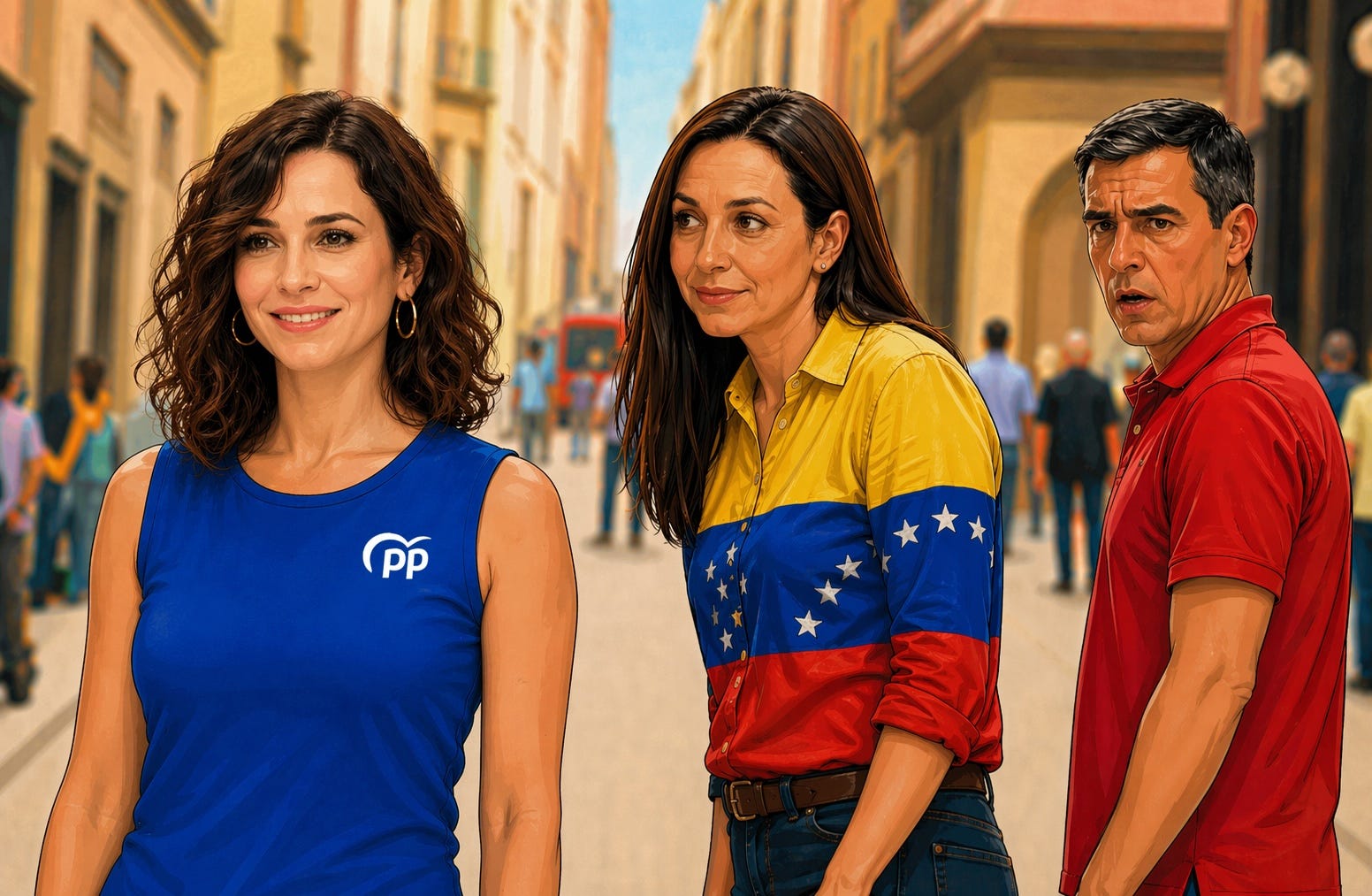
Guess who was in town? María Corina Machado, leader of the Venezuelan opposition and recent Nobel Peace Prize winner, spent the weekend in Madrid and was welcomed like a head of state… just not by the Spanish government.
¡La Presidenta! Machado, who is widely seen as the real winner of the country’s last elections (even though she was disqualified from running), landed in Spain to a reception that felt closer to a victory tour than a diplomatic visit.
Tighty righties. She met center-right PP leader Alberto Núñez Feijóo at party headquarters — where she was greeted with applause and chants of “libertad” — and then far-right Vox leader Santiago Abascal for good measure.
But wait, there’s more! Machado also held high-profile meetings with Madrid’s regional president, Isabel Díaz Ayuso, and Madrid mayor José Luis Martínez-Almeida.
Want something shiny? Ayuso awarded Machado the Gold Medal of the Community of Madrid, and Almeida handed her the symbolic keys to the city, a gesture usually reserved for heads of state or major historical figures.
The optics mattered. Madrid is home to one of the largest Venezuelan diaspora communities in Europe. Some 200,000 people who fled the crisis back home came to the city.
Many of them see Machado as their political representative, so her appearance at the Puerta del Sol, where she addressed a crowd of supporters waving Venezuelan flags and chanting her name, felt like a campaign rally (albeit in exile).
Where’s Pedro? Despite being invited, Machado did not meet with Prime Minister Pedro Sánchez nor anyone else from the Spanish government. Eeeeenteresting… 🤔
The water simmers. The awkwardness of not meeting started politely, through clenched smiles. Sánchez said he was “delighted to meet Señora Machado whenever she has the opportunity” — the doors of Moncloa, he added, are always open. Machado had said that meeting him simply “no es conveniente” (“It is not advisable.") right now. Nothing personal, you understand.
But really, what's up? Machado nodded at one reason she didn't meet Mr Handsome —the progressive summit he was hosting in Barcelona, which featured left-wing leaders of countries like Colombia, Brazil, and Mexico who'd been kinda friendly with her nemesis, now-jailed Nicolás Maduro.
Now we get it. She added some spice in an interview with El Mundo: “Meeting with Pedro Sánchez would have sent the wrong message; our cause is about truth and about the people.” Ouch.
The water boils. Then Foreign Minister José Manuel Albares started punching back on RNE. Machado, he noted, had managed to meet Feijóo, Ayuso, Almeida and Abascal: “She has acted as an ideological leader meeting with her political spectrum, which is the Spanish far right.”
A little gratitude, please. Albares reminded everyone that this government flew Machado’s proxy Edmundo González out on a military plane and just rushed Spanish citizenship to fellow opposition leader Leopoldo López (who previously found asylum in Spain’s Caracas embassy). “Is it necessary to hide what Spain does for Venezuela in order to please others?” (Who are those others? Just wait…)
The pot explodes. Albares dropped a bombshell: Machado herself, he claimed, had once asked for refuge inside Spain’s Caracas embassy, and he’d granted it.
Calling bull💩. Machado’s team called that “false.” Diplomatic sources told El Mundo the offer went the other way. And Machado fired back… obliquely: “There are opaque episodes” around Spain’s dealings in Venezuela, she told El Español, and “I have information others don’t” — that will be deployed once verified, we presume. 🤔
So what’s going on here? Two things, probably.
First, of all European governments, Sánchez’s has been friendliest to Maduro — which doesn’t exactly build trust with the Venezuelan opposition.
But more importantly, Sánchez and Trump are at each other’s throats, and Trump is the one who might actually install Machado in Caracas — having, in January, ordered the Fuerte Tiuna raid that dragged Maduro off to a New York cell. ”The only head of state who put his citizens’ lives on the line for our freedom,” she gushed in El Español. A bit thick, but she knows which side her arepa is buttered on.
P.S. Watching Leopoldo López try to avoid getting involved in the Machado/Sánchez spat in this interview is hilaaaaaarious. Dude will say anything to say nothing. Deer in headlights total.
More news below. 👇👇
💬 Five things to discuss at dinner parties
1. 🧑🏻💼 Pedro Sánchez has an international fan club, but…
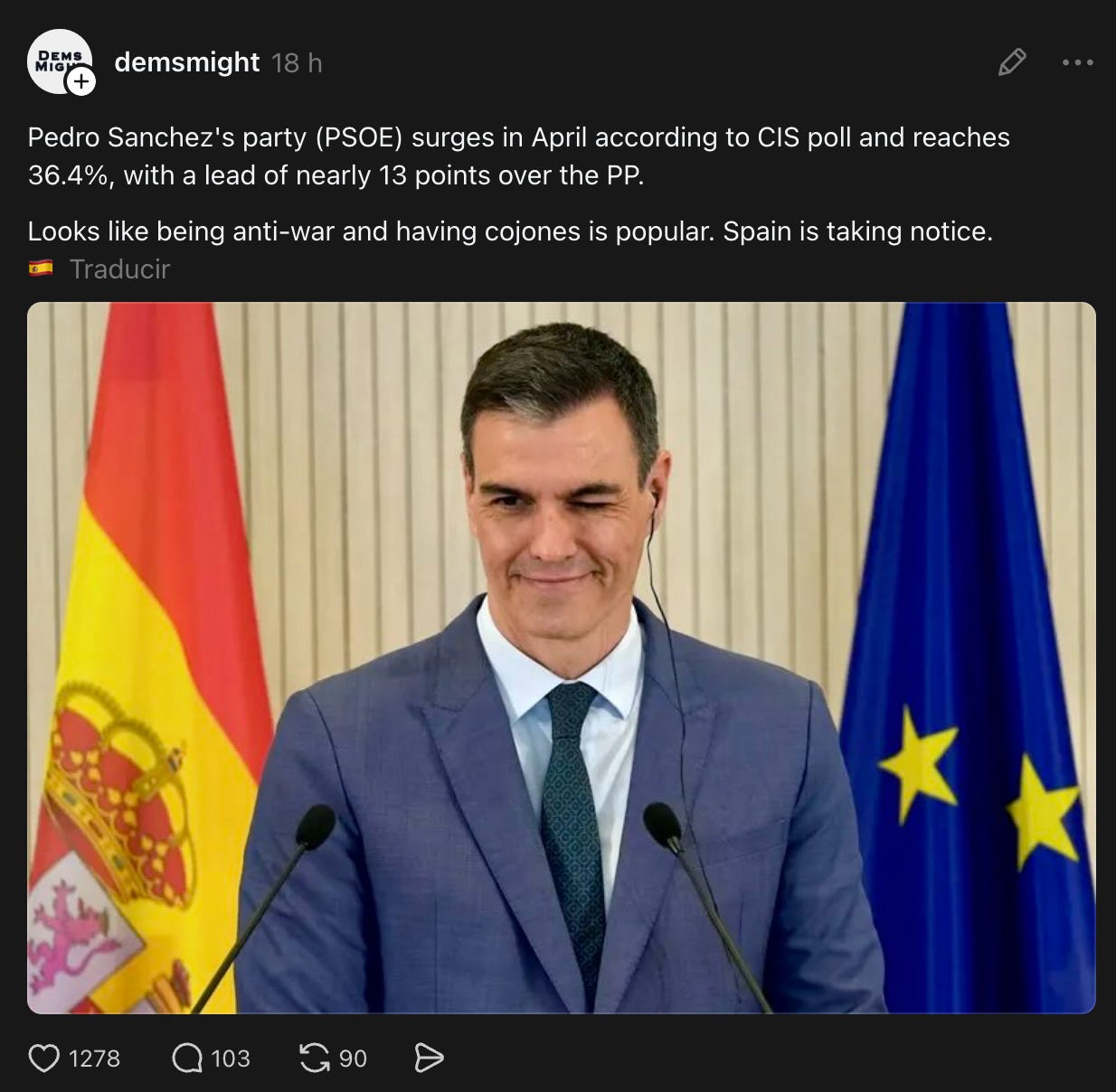
The Prime Minister’s moves to take on Trump and Netanyahu, as well as his recent confab of the international left in Barcelona, have brought him a sizable fan club abroad. And that fandom went up 11 on Monday, when the CIS public research institute’s April poll showed Sánchez’s PSOE extending its lead over the center-right PP to 12.8 points, 36.4% to 23.6%.
Overseas praise flooded social media, like the post above from DemsMight, a pro-Democratic party (U.S.) messaging group: “Looks like being anti-war and having cojones is popular. Spain is taking notice.”
But there’s a data problem. The CIS has a certain cachet — publicly funded, historically respected — but in recent years, well, not so much. After taking office in 2018, Sánchez appointed sociologist José Félix Tezanos — then a sitting PSOE executive committee member — as chair. Since then, the rosy poll numbers the CIS hands the PSOE have been wrong so often that they mostly qualify as wish fulfillment.
Seriously, that bad. As friend-of-Bubble Kiko Llaneras of El País has documented, the CIS under Tezanos has overestimated the left in 41 of the 42 elections analyzed since 2018. (Another analysis finds that the CIS underweights support for the right — PP + the far-right Vox — by 11 percentage points on average.)
Plenty better ones. Private pollsters like 40dB. and the El País poll-of-polls have been consistently more accurate, while the CIS lives in a parallel (inaccurate) universe where the left almost always does a bit better than in real life.
It’s not just the numbers. Former members of the CIS advisory council — including old friends and heavyweight sociologists — have filed formal complaints and quietly walked away, decrying the “CIS de Tezanos” brand that now clings to the center like bad cologne. One described it bluntly as “the least neutral institution in Spain right now.”
But has Sánchez’s Trump pushback helped? Yes — just not as much as the CIS suggests. Polls by SocioMétrica for El Español have found that the PSOE would win 110 seats (out of 350) if elections were held today, up 12 from two months ago, just before Sánchez took his stand against the war. That growth has come at the expense of the PSOE’s far-left allies and Vox; the PP held steady with 140, and could still form a majority with Vox.
Does playing with the numbers help your side? Doubtful — and Sánchez may not trust the CIS polls himself. As the commentariat often notes, if he actually believed he had a 13-point lead, he’d call elections tomorrow.
Our take. Sánchez’s pushback on Trump is paying dividends (and is eminently justifiable). But Spanish voters are tired of him for many other reasons, and won’t switch to him en masse for heckling the Orange Menace. Indeed, Sánchez may be turning into Southern Europe’s Mikhail Gorbachev — popular abroad and unloved at home. Maybe the UN has a job for him?
2. 🤝 PP and Vox finally strike a deal in Extremadura (and it’s… complicated)
Cue the Imperial March from Star Wars. More than 100 days after the regional elections, regional president María Guardiola’s PP and Vox have reached an agreement to form a government in Extremadura.
The deal secures a four-year coalition. Vox will form part of the government with a vice presidency, two ministries, and a regional senate seat.
This is big news because it wasn’t supposed to be this easy, or even happen. Guardiola openly clashed with Vox leader Santiago Abascal during the campaign, even accusing him of “machismo,” and initially resisted governing with his party.
Agree to disagree. The deal itself is broad (61 points and 74 measures), but it’s the content that’s raising eyebrows. Among (many) other things, the coalition is pushing for lower taxes; a tougher stance on immigration; a ban on burqas and similar garments in public spaces; and a clear rejection of parts of the EU’s Green Deal and the UN’s 2030 Agenda. It also includes measures to “protect” the agricultural sector from Brussels and to extend the life of the Almaraz nuclear plant.
The most controversial part? The so-called “national priority” principle. On paper, it prioritizes access to public aid, like housing and social benefits, for those with a “real, durable connection” to Extremadura.
But, but, but… In practice, critics say it’s a backdoor way of discriminating against immigrants. The policy would favor long-term residents regardless of nationality, but it also explicitly seeks to limit access for people in irregular situations and calls for reforming Spain’s immigration law to make this possible.
Slight problem. Under current Spanish and EU law, this kind of discrimination is likely illegal, and the backlash was immediate. The PSOE labeled the pact “racist” and warned that it would challenge any discriminatory measures in the Constitutional Court.
Surprise! Even within the PP, there’s discomfort: Madrid regional president Isabel Díaz Ayuso publicly questioned the legality of “national priority,” arguing that “you can’t exclude people who have rights and contribute.”
Another surprise! Yesterday afternoon, emboldened by what was happening in Extremadura, Vox went on a series of, ahem, “controversial” statements about non-Spaniards in Parliament and insisted on the need to reform Spain’s immigration law. The PP chose not to confront them on the floor but then low-key sided with PSOE and voted against their motion, effectively killing it. Sad!
Business as usual. Guardiola, for her part, is trying to walk a fine line. On Tuesday, she insisted the government will “never break the law” while doubling down on the message that Extremadura won’t “pay the price of a broken migration model.”
She said this isn’t exclusion, but fairness for those who “have been contributing for years.” Then, after being officially voted in as the new regional boss yesterday (see video above), she said "she wouldn’t apologize” for governing with Vox.
Other unholy alliances. While Vox and the PP are still trying to reach a deal in Castilla y León, the parties announced yesterday that they had also reached a deal in Aragón. Expect the debate over immigration to get a lot louder.
3. 🛂 The mass regularization of immigrants has begun — and everyone’s fighting about it
No one could have predicted this. Okay, everyone predicted this. Ram through a mass regularization via a questionable decreto real during peak culture war, and you’d expect just a little chaos and fighting. And we got it — in spades. Let us count the ways.
First, shambles. “The queues we see are only for getting the documents,” government workers deadpanned to La Voz de Galicia, after NGOs and municipal offices found scores of applicants asleep on cardboard outside their offices, waiting for Monday’s first in-person slots.
So many people. Madrid’s daily applications leapt from 1,500 to 5,500 in a week. Outside Aculco, a Madrid NGO that handles 300 a day, hundreds queued from the night before. “We’re overwhelmed — we didn’t expect this,” director Álvaro Zuleta told CNN. The government’s own prep? A Friday-at-5:38pm email begging the Federation of Spanish Municipalities to pitch in.
The biggest confusion. Municipal offices and NGOs have been slammed by applicants seeking a “certificate of vulnerability” — except no one quite knows how to certify it. Madrid’s social-policy chief (of the PP, so not a government fan) says functionaries are working practically blind. Valencia mayor María José Catalá (also PP) was blunter: “If the Minister of Inclusion, Elma Saiz, says that any undocumented person is vulnerable [which she kinda did], then the question is: why is a certificate required to prove it?“ Catalá is also asking Madrid to pay her city’s €1 million paperwork tab.
Second, prisoners. The Ministry of Interior quietly instructed Spain’s 80 state-run prisons to help inmates in preventive custody — some 3,500 foreigners without convictions — apply. The opposition? Not happy. “A preventive prisoner is someone a judge has sent to jail over the risk of flight or recidivism,” PP’s Alma Ezcurra tweeted.
The worry? Paperwork moves faster inside prison than for migrants on sidewalks — and once regularized, deportation gets much harder. The move is probably fair — innocent until proven guilty and all — but not a great look.
Third, scams. Appointments for empadronamiento (residence registration) or to file paperwork at Correos are both free. A black market has sprung up anyway.
Nayeli, a Mexican student, paid €150 for a padrón that never materialized; others report quotes of €400 for padrón and €600 for a single Correos slot. Police say mafias use bots to hoover up appointments and resell them in locutorios. The government delegate in Catalonia has had to beg consuls to tell their citizens: “Nobody has to pay a single euro.”
This probably isn’t making the whole regularization any more popular. SocioMétrica’s poll for El Español finds 66.7% of Spaniards against it — rising to 80.5% among 17-to-25-year-olds. Polls are famously imperfect, but those aren’t great numbers. “Spain is the daughter of immigration and will not be the mother of xenophobia,” Sánchez said. Fine sentiments. But Spaniards, it seems, are unconvinced.
4. 🦠 A Valencia med school gave anatomy students cadavers infected with Hep C and COVID