

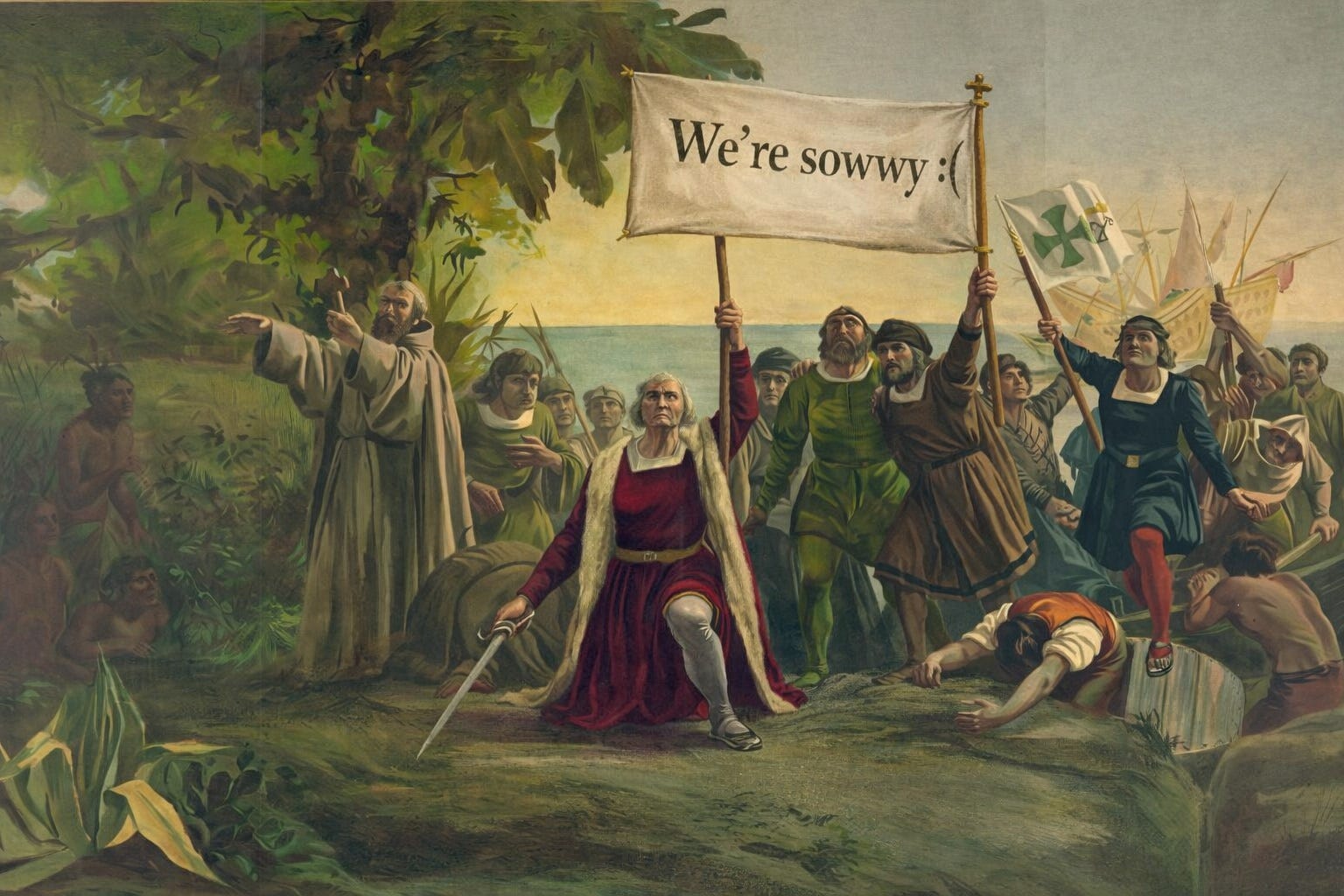
🌎 King to Mexico: "We're sorry" (Kind of)
Also: Torrente for President, and is the new rent-control system working?
Madrid | Issue #140
🇪🇸 The Bubble is Spain's #1 English-language, best-selling newsletter. We offer paid subscriptions, and we’d be thrilled to have your support!
🚨 Customize your subscription! You can personalize your Bubble experience so you only get the emails you want—and never the ones you don’t. Click here to learn how.
📺 Sponsorship opportunities. Want to get your brand in front of our engaged and influential audience of professionals, creatives, and government workers? We’re now offering a variety of ways to do so. Click here to find out how and book a spot.
Coming to America
🇲🇽 King Felipe VI almost says sorry for that conquest thing
Surprise! King Felipe VI (aka F6) raised a few eyebrows this week after casually acknowledging that there was “a lot of abuse” and “ethical controversy” during the Spanish conquest of the Americas.
Audible gasp. He made the comments in passing during a low-key visit to an exhibition on pre-Hispanic cultures at Madrid’s National Archaeological Museum, alongside Mexico’s ambassador, an appearance that wasn’t even on his official agenda but carried very clear political weight.
That's reasonable. On paper, it sounded like a fairly balanced, almost academic reflection. As in, yes, there were abuses, but historic acts should be judged “in their proper context, not with modern moral lenses, but with an objective and rigorous analysis.” In practice, it worked like a diplomatic flare sent over Mexico.
Tough times. Relations between Spain and Mexico have been tense for a few years, ever since former Mexican president Andrés Manuel López Obrador (AMLO) formally asked the King in 2019 to apologize for the conquest (and, not surprisingly, got radio silence in return). Things escalated when current president Claudia Sheinbaum didn’t invite F6 to her inauguration. ☹️
King knew what he was doing. By publicly acknowledging “abuse” this week, the King is inching closer to the kind of recognition Mexican leaders have been demanding, without actually issuing an apology. Like, “We're sorry that you're upset.”
Why now? Some believe this isn’t just about revising history, it’s actually about saving the Iberoamerican Summit taking place in Madrid later this year, which is supposed to bring together leaders from across LatAm and Spain — and there was a risk that Sheinbaum might skip it. (Ah, now we understand.)
Better than nothing. Sheinbaum, commented that she “recognizes and values” the King’s gesture, and added that, “It wasn’t everything we would have liked, but the truth is that it’s a gesture of rapprochement.” So, coming to the Summit, Claudia?
In the loop. Spain's PSOE-led government said it “fully endorsed” the King’s remarks and that it was aware of what he was going to say.
But not everybody was so happy. In case you don’t know the Leyenda Negra (“Black Legend”), it’s the idea that Spain’s imperial history has been unfairly portrayed as cruel and oppressive. So for many in Spain, criticism of the conquest isn’t just about history — it’s accepting a centuries-old misrepresentation of the country. (Many of those same people are not fans of PM Pedro Sánchez, you will be shocked to hear.)
Absurd time shift. The leader of the PP, Alberto Núñez Feijóo, talked up his pride in the Spanish legacy in the Americas. Plus, like, timeline? “To examine events that occurred in the 15th century in the 21st century is absurd,” he said.
No, you. Madrid’s regional presi and troll artist Isabel Díaz Ayuso let it all hang out, suggesting Sheinbaum might look closer to home: “Abuses are what were committed against the native population by the Aztecs and Mayans, who used sacrifices as part of their rituals.”
Far-right Vox got even puffier with Spain pride. Its parliamentary spokeswoman argued that the Spanish Crown carried out “the greatest evangelizing and civilizing work in history.” No apologies here!
This will probably blow over quickly, and there's a good chance that Mexico's president will attend Spain's summit. But the big winner of this whole kerfuffle is probably the King: after his non-apology apology, Sheinbaum invited F6 to attend this summer's World Cup in Mexico.
Considering how hard it is to get those tickets, we suspect that might have been F6's angle all along. 🤔
More news below. 👇👇
🔔 But first, check out this job opportunity at 2btube

Looking for a career move in Spain? Two big opportunities just landed.
Our friends at 2btube are hiring a senior international Content Head (fluent in Spanish & English, French is a plus) to help shape the future of digital content in Spain, leading YouTube content strategy and viral IP creation. Think MrBeast, but make it Spanish (Yes, this is one of those jobs people humblebrag about later). They are also looking for a CTO who focuses on AI and tech strategy, powering it all.
If this sounds like you — or someone you know — check out the job descriptions here.
💬 Five things to discuss at dinner parties
1.🗳️ Castilla y León votes, the PP wins, little changes
Oh, look. More elections. Castilla y León voted this weekend and, spoiler alert, nothing really changed, but also everything did. The PP (currently in power there) won the election with 33 seats, improving its result but still far from the 42 needed for a majority, which means regional president Alfonso Fernández Mañueco is back where he started — needing Vox to govern.
This is beginning to become the PP’s theme song. This also happened to them in the last three regional elections — Extremadura, Aragón, and now Castilla y León.
Booby prizes. The PSOE came second with 30 seats (gaining two in a small recovery after recent defeats), while Vox got 14, gaining just one seat and failing to break the symbolic barrier of 20% of the vote. Regional parties held their ground (ish), and the farther left basically
dieddisappeared from the map.
Half full, half empty. Sure, the PP is still dependent on Vox despite their victory. But Vox’s growth was smaller than expected. In fact, the PP almost doubled Vox in votes, effectively clamping down on the far-right party in a region where they expected to surge.
Mañueco wasted no time reading the room. He’s already calling for a “four-year parliamentary agreement” with Vox, but with a twist: he’d prefer they support him without joining the government.
Meanwhile, the PSOE has made it clear it won’t play along. Candidate Carlos Martínez flat-out rejected facilitating Mañueco’s investiture, essentially hoping for a repeat election rather than helping the PP govern.
It’s bleak for the left. The right dominates in Castilla y León and has been in power since 1987. Governing from the left would require something close to a political miracle.
Next stop. The next big regional elections are in Andalucía in three months, although they may bring elections forward to May 31 to avoid the Pope’s visit in June hijacking the campaign. Get ready, that one is going to be a shitshow fun.
2. 🏘️ Is the new rent-control system working, 2 years in?
On March 16, 2024, Catalonia instituted the first rent controls under a new law allowing regions to cap prices in “stressed areas,” passed by the PSOE-led government after years of fast price increases (rents in Catalonia had risen 60% in a decade). So now we ask, with two years of data, did they actually work?
Caveat emptor. Like with everything in Spain, whether you think they worked tracks closely with whether you like the party that passed them. But hey, that’s why we’re here!
Top line: prices cooled. In Catalonia’s “stressed zones,” rents rose just 0.8% over 18 months, well below inflation (3.1%), while unregulated areas saw a 5.7% increase.
In Barcelona, prices actually fell 3.3%. As urban researcher Jaime Palomera says, the caps “broke the previous trend” of runaway increases and helped stabilize prices. In Navarra, prices fell 8.8% between the second and fourth quarter of 2025. Even critics concede some downward movement.
But, but, but… Don’t pop the cava yet.
Lies, damned lies, and statistics. Prices spiked right before the caps came in (landlords raised their prices while they could), making the subsequent “drop” look bigger than it really was. Adjust for that, and a study from the Instituto Juan de Mariana (a libertarian-leaning think tank) says the decline is basically a rounding error.
What you get has shrunk. Average apartment sizes are down (in Barcelona, from 75m² to 71m²), while the price per square meter has stayed high or even hit records. In other words, you’re paying more for less space. Which is cozy!
And then there’s the supply (or lack thereof). Across regulated cities, rental listings have dropped sharply — about 26% in Pamplona, 21% in A Coruña, and 15% in Barcelona, according to Idealista data. In some places, registered rental contracts have fallen by as much as 50%.
So where did those rental apartments go? 🔎 Well, they escaped. Seasonal rentals (which do not have price caps) have exploded — in Barcelona, they jumped from about 7% of contracts to over 23% in two years.
Others have been sold off, with institutional landlords fleeing the “stressed” markets.
Our take? Rent caps are a sugar fix. They feel great at first — prices stop rising, politicians take a bow — but they don’t solve the underlying problem.
Spain is short some 800,000 homes (and growing). If renting stops being profitable, fewer homes get built or offered for rent. Which means even less supply in the places that need it most.
And allies of the governing coalition are talking about new limits. “We see that the supply is decreasing, but prices are not falling,” says Montserrat Junyent, who runs the real estate agents’ lobby of Catalonia. “And all that is being adopted are new regulations that exacerbate the housing problem.”
So yes, prices stabilized (ish). But at the cost of fewer homes, more loopholes, and a market that’s increasingly weird. Short term? We’re all a bit screwed. Long term? Maybe we can build our way out. Maybe.
And if you already own a place? Smile. Quietly. And for the love of God, don’t brag about it. Angry Gen Zers stuck at home forevs may show up with pitchforks.
3.🎬 Spain has a new “president” (and it’s Torrente)
The Spanish box office has a new (and deeply horrible) president, and his name is Torrente. After more than a decade away, Torrente presidente (“Torrente for President”), the sixth installment of Santiago Segura’s legendary saga about the worst person imaginable, hit cinemas this weekend and absolutely blew up the box office, pulling in around €7m in just a few days.
That makes it the fourth biggest opening in Spanish film history, and, because this is Spain, three of the top four are Torrente movies. At this point, Segura is competing with his own past self.
Wait, who? For the uninitiated (shame on you), Torrente is one of the most iconic and controversial characters in Spanish pop culture.
Think of a deeply corrupt, outdated, ex-police officer who embodies every bad stereotype imaginable. Like, sexist, racist, homophobic, islamophobic, lazy, loud, and proudly wrong about everything. In other words, the ultimate “cuñao.”
The more you know. A cuñao (a mispronunciation of brother-in-law) is Spain’s version of the crazy, racist uncle. He is that guy at the bar who talks bullfighting, soccer, and sevillanas, and has an opinion on absolutely everything that he delivers loudly, confidently, and usually incorrectly over a chupito.
A pretty topical movie. In Torrente presidente, the titular character joins a fictional ultra-nationalist far-right party called Nox (subtle, we know) and climbs his way into power, exposing corruption, incompetence, and hypocrisy along the way.
The film makes fun of everyone (left, right, and center) and clearly has fun skewering populism, media spectacle, and the general circus that politics has become. The uncomfortable part? A lot of the jokes feel a little too close to reality, which is exactly why they land.
It’s filled with cameos from real-life political figures and guest appearances such as former PM Mariano Rajoy (we’re not kidding), Alec Baldwin, and Kevin Spacey (again, we’re not kidding).
Numbers as ridiculous as the premise. The film has already passed 1 million viewers in record time, is dominating more than 70% of the total box office, and has become the highest-grossing Spanish film of 2026 in a single weekend.
4.😳 It’s Spanish culture shaming week!
Maybe it was war stress? Or Oscar nerves? Whatever the cause, it’s been a cranky week in Spanish culture. Let us count the ways…
We’re going to start on the fútbol pitch. Because if you don’t think fútbol is culture here, you don’t know Spain.
Spain v Argentina. The continental champions were supposed to play a Finalissima on March 27 for ‘Best in the World’ bragging rights. Great. In Doha. Less great (the war and all.)
They needed a new location. So they negotiated. And then on Sunday, the European soccer federation, the UEFA, announced that the game was off.
What? The UEFA blamed Argentina — loudly — laying out all the offers they made that were rejected, and how a last minute change by the Argentine federation made the cancellation inevitable.
The conspiracies went wild. Clarín suggested that the Argentine coach, Luis Scaloni, didn’t want to play and risk a loss that could break the team’s confidence ahead of the World Cup. Or maybe it was because Argentine federation boss Claudio Tapia, who is facing a fraud investigation with links to Spain, was afraid of being arrested in Europe? 🤔
And then there’s poor Rosalia. Rosi probably thought she was doing her fans a solid when she sat for a chat with Argentine writer Mariana Enriquez for Spotify Presents.
Rosi said some things. While discussing Pablo Picasso, Rosalía said that while she might not have liked Pablo had she met him, “I’ve never had a problem with differentiating between the artist and the work,” and that, unless she’d had a real experience with him, “Who am I to judge?”
The interwebs attack. The social media commentariat was not amused and noted that biographers had documented Picasso’s psychological violence and emotional manipulation, and two of the painter’s partners later committed suicide.
Modern self-flagellation. A chastened Rosalía
set herself on fire on stagerecorded a contrite TikTok in which she apologized to her fans and said they were right that she should have known more about Picasso, and please don’t cancel her.
Finally, Yolanda Díaz. You’d think the retiring leader of a party of small and decreasing importance could be ignored on a nice work trip on the government’s dime. But you’d be wrong.
Gallegos of the world unite. Díaz grabbed a commercial flight to Los Angeles for the Oscar ceremony Sunday, apparently at the invitation of a fellow gallego, Óliver Laxe, who directed the Spanish film Sirāt that was nominated for best international picture (and lost).
But that ticket! Spanish media dug up that her business class ticket and that of her assistant each cost €7,700, and they stayed at a hotel where rooms cost about €500. So, you know, scandal.
Fashion press piles on. Trade journal Fashion United noted that Díaz attended the Oscars in a dress from Purificación García, whose stores in Galicia are being picketed by striking members of the union that makes the clothing. Which maybe is a bad look for a leftish Labor Minister.
Feeling superior yet? Good. Next story.
5.🏰 Spain just lost a piece of a medieval castle
Boom. The surreal moments in the footage above look as if they belong in a disaster movie rather than in a sleepy town in Castilla-La Mancha. What happened? On Saturday, the Albarrana tower, part of the Escalona castle, in the province of Toledo, suddenly collapsed.
Thank god for social media. Tourists standing nearby captured the whole thing on video as the tower collapsed in a very dramatic cloud of dust. The good news is that no one was injured, though a few unlucky cars parked nearby ended up taking some stone souvenirs home.
Sad face. The Castillo de Escalona is not just another crumbling ruin in rural Spain; it’s one of the most historically significant fortifications in the Toledo region.
Old… Parts of the complex date back to the 11th century, when the original tower was built during the Islamic period, while later expansions in the 15th century turned it into the imposing medieval stronghold locals know today.
And new again! The castle remained closed for decades and was largely neglected until 2024, when the town council bought the site and began reopening it to visitors, allowing people back inside for the first time in more than 50 years.
The culprit. According to local authorities and heritage experts, the collapse was caused by water damage. Spain has experienced intense storms recently, and the rainfall appears to have seeped into the tower’s interior walls.
Oh, the irony. The collapsed tower was slated for restoration, but the works hadn’t started yet. One small piece of good news in this architectural tragedy is that the original 11th-century core of the tower remains standing, which means part of the structure may still be preserved.
Not an isolated incident. Spain has one of the largest concentrations of castles in the world, with more than 10,000 fortifications scattered across the country.
In theory, they’ve been safe since 1949, when Franco issued a decree to protect them. In practice, this often meant little more than good intentions.
Historians of Spain’s fortifications are blunt about the situation. Miguel Sobrino, author of Castillos y murallas, describes the overall condition of many castles as “calamitous, catastrophic.”
Many were destroyed during the Napoleonic wars in the 1800s, and later, in the 20th century, others were literally sold off stone by stone, before modern heritage protections existed.
🙏 Once again, please remember to share this newsletter with your friends on social media. The more we grow, the more information we’ll be able to offer each week.