

🌍 A million migrants and counting
Plus: Goodbye to LGBT conversion therapy and hello to Spain's biggest tax dodgers.
Madrid | Issue #153
🚨 The Bubble is Spain's #1 English-language newsletter. We offer paid and free subscriptions (which you can customize). Or interested in sponsorship opportunities?Click here to find out how to book a spot.
That's a LOT of people
🛂 Give us your tired, your poor…ah, hell, give us everybody.
Remember Spain’s controversial massive migrant regularization program? Well, it just blew past expectations (way past!), and it’s now turning into one of the biggest social and political bets of Prime Minister Pedro Sánchez’s government.
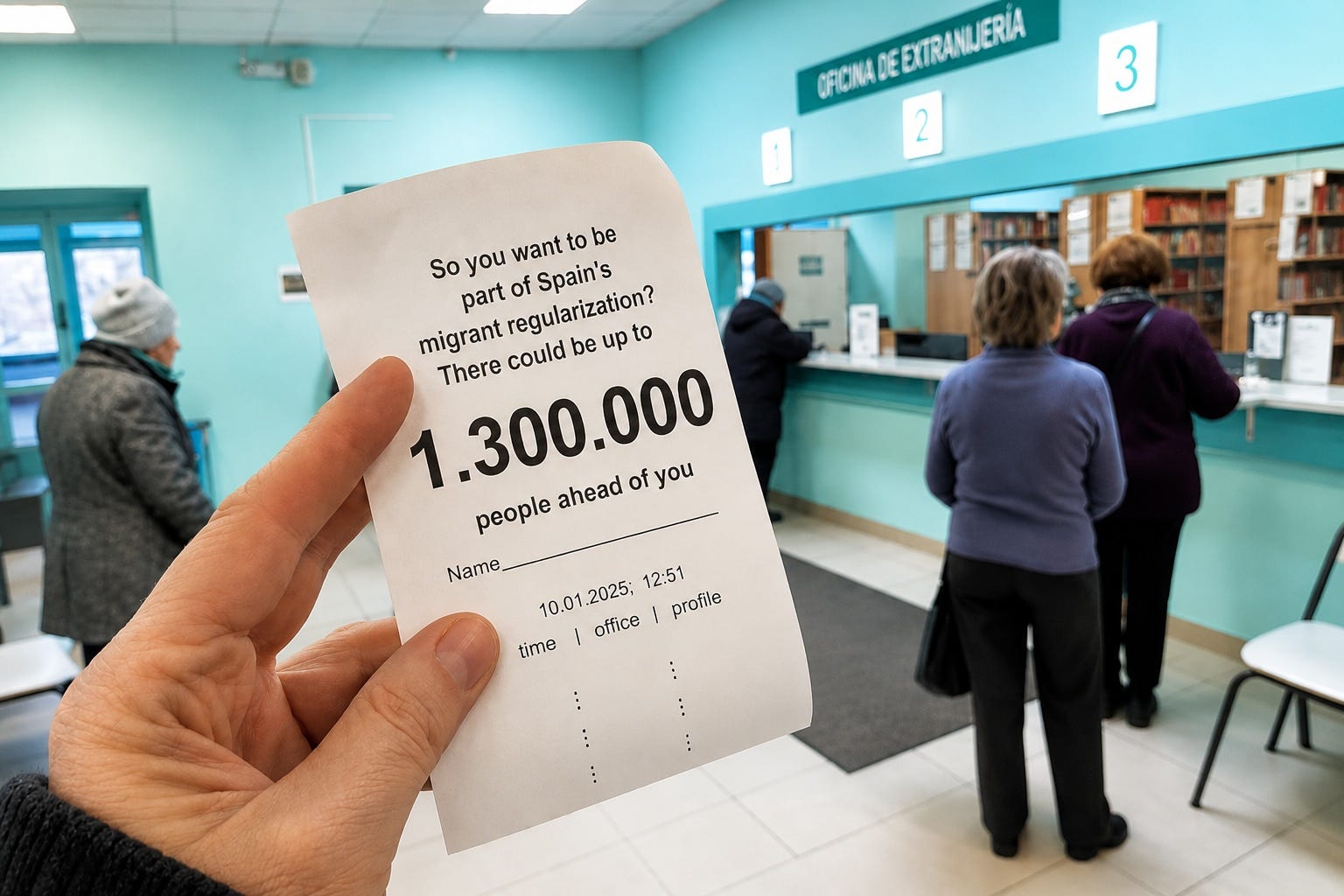
1.3 million! The deadline to apply passed on Tuesday, and while the government predicted around 500,000 undocumented migrants would apply, early estimates now suggest the number could be as high as 1.3m. 😵💫
The government hasn’t confirmed the final figure yet, but even its own mid-June data (900,000) already showed the scale of the surge. This would be the largest regularization in Europe in decades.
UPDATE: After this newsletter was sent, the government confirmed a total of 1.174.978 petitions made (67% of them from Latin American citizens).
A big f*cking deal. In simple terms, the process allows undocumented migrants already in Spain to obtain legal residency and work permits (citizenship could come after years of residency).
The government’s argument is both moral and economic. That is, these are people already working — often off the books — and bringing them into the system means taxes, contributions, and legal protections.
Sánchez has made big claims. He has framed mass immigration as essential to sustaining the economy and says thousands of businesses, farms, and schools would disappear without migrant labor. Without immigration, he claims that Spain would lose 19% of its GDP by 2050. Now, this Big Scary Number is a guesstimate, but considering Spaniards are not having kids, he may be pointing in the right direction.
Training. Alongside the regularization, the government has launched a €500m integration plan, focused on employment, training, housing, healthcare, and social cohesion (language programs, etc).
Immigrants have been powering the economy recently. Since 2018, Spain has added 2.9m jobs, and some 44% of them have gone to foreign workers who help offset Spain’s aging population and labor shortages.
Party poopers. The center-right PP and far-right Vox (shocker) have come out strongly against the regularization, warning of an “efecto llamada” (a pull effect) that could encourage more irregular migration.
The police are fueling that argument. They originally warned that the number of applicants would be much higher than the government's 500,000 estimate. Their internal estimates also suggested that up to 400,000 applicants may not have been living in Spain before the official cutoff date, raising concerns about fraud, forged documents, and a potential black market for fake proof of residency.
EU gotta be kidding me. Spain’s Supreme Court is now considering whether the policy could conflict with EU law (i.e., Schengen rules). It has asked both the government and several PP-led regions whether it should refer the case to the European Court of Justice (CJEU).
Basically, EU citizenship. Judges are concerned that it would grant over a million people free movement across the EU and may conflict with EU migration law, especially since it was done without coordination with Brussels or other member states. Sánchez’s government, however, has said the permits are only for Spain (hmmm). And the European Commission has already signaled that migration regularization is a national power, not an EU one.
It’s not just the massive regularization that has the opposition up in arms. They’re also on fire about a massive naturalization — that of Spanish emigrants and their children abroad through a law known as the Ley de Nietos (The Grandchildren’s Law). Funny thing? Some of them used to support it.
The Ley de Nietos is a provision of the 2022 Ley de Memoria Democrática granting Spanish citizenship to grandchildren of Civil War exiles and Franco-era emigrants. Applications closed in October 2025 with 2.45m submitted — mostly from Argentina (1.5m) and Cuba (800,000). Some 544,722 have been approved; 306,000 are now on the electoral roll.
The awkward part. PP leader Alberto Núñez Feijóo campaigned in Buenos Aires in 2023, promising a “specific law” to grant nationality to descendants of Spanish emigrants. In 2018, PP voted in favor of a similar Senate measure — and as Galicia’s president, Feijóo spent years defending the Galician diaspora’s right to a Spanish passport.
Now, though. This week Feijóo called the law “electoral engineering” and accused Sánchez of “manufacturing voters.” Vox’s Abascal went further, alleging a full pucherazo (vote-rigging). Madrid presi Isabel Díaz Ayuso warned consular officials they could face legal consequences for granting citizenship to those “who don’t deserve it” — which pissed off Spain’s diplomatic corps, traditionally conservative and deeply unused to being accused of electoral fraud by the right. The government called all of it “trumpismo” — and Reuters drew the same parallel, explicitly comparing the rhetoric to Donald Trump's and former Brazilian president Jair Bolsonaro’s election-denial playbooks.
The mail-in twist. Vox is now demanding that the Junta Electoral Central suspend postal voting for all Spaniards abroad — the better to protect democracy, we assume. But the irony: in the 2023 election, PP beat PSOE in overseas votes 32.7% to 24.9%. The overseas vote, as it stands, is a PP stronghold.
More news below. 👇👇
🔔 Don’t miss the latest episode of The Bubble Podcast!
Episode 2 of The Bubble Podcast is out! We talk about true crime (maybe), how to enjoy this summer’s verbenas, and mistakes foreigners make when moving to Spain.
Subscribe on Spotify, Apple Podcasts, and YouTube!
💬 Five things to discuss at dinner parties
1. 🤑 Spain’s Tax Man releases the 13th annual list of biggest tax dodgers!
Just like some Spaniards get all fired up about Semana Santa, Pride, or MadCool, we anxiously await the annual release of the biggest tax debtors. Because…we’re weird, and because we just loved following Shakira’s multi-year fight with Hacienda, which she won, in part, because her hips don’t lie, usually.
The 2025 list doesn’t disappoint. The list includes 5,853 debtors, down 2.4% from last year, and at first glance, total debt looks lower — €15.4bn, off 4.4%. But strip out duplicate entries, and it’s actually 12.2% more than last year. Well done, cheats!
The threshold to make the list: owe more than €600,000, debt firm and uncontested as of Dec. 31, 2025.
But we’re not here for the stats; we’re here for the celebrities.
Back after two years off, TV presenter Patricia Conde returns with €714,615 pending. ¡Bienvenida!
Back after three years: Gossip TV regular Kiko Matamoros squeaks back in at exactly €600,740. Well done, but we’ll expect more next year!
Going up 📈: Isabel Pantoja’s debt has grown from €1m to €1.3m. Singing more, paying less. Paz Vega (real name María Paz Campos Trigo) is up to €1.8m. And El Chatarrero — a scrap metal mogul and right-wing gossip-press regular named Luis Miguel Rodríguez — has gone from €3.7m to €4.35m. 🎇 Lol, and to think your simple autónomo debt keeps you up at night.
Going down (slowly) 📉: Bertín Osborne, the singer, right-wing(ish) TV star and…9th Count of Donadío de Casasola, still owes €835,000, though at least it’s trending the right way — notable given he just launched a new telecom company with the slogan “things done right, things done correctly”. Mario Conde, the former banker-turned-politician, has brought his tab from €6.4m in 2023 down to €1.9m. Points for effort.
Leaving: Diego Torres, of the Nóos corruption case (remember the one involving the King’s brother-in-law?), has made it off. ¡Chao! 👋
The corporate heavyweights: Real people are fun, but the serious money is corporate. Reyal Urbis, a real estate firm, has led the list every year since 2015 and owes €264.9m. Behind them: a parade of oil companies under investigation for VAT fraud — Bio-Zenite Energy (€232.9m), Metaway Combustibles (€195.6m), Vertix Petroleum (€194.7m).
The list was created in 2015 as a financial shaming mechanism. Does it work? Somewhat: €79.5m was paid right before the Dec. 31 deadline, presumably to avoid appearing. The problem is that 20% of the total debt (€4.3bn) belongs to companies in bankruptcy proceedings — meaning it may never actually be collected.
Dream on. Someday, we hope to have enough 🫰to be that far in tax debt.
2. 🏳️🌈 Parliament criminalizes “conversion therapy”, at last
Just in time for Pride Week. Parliament has approved a reform of the Penal Code to criminalize the so-called “conversion therapies,” practices aimed at changing or suppressing a person’s sexual orientation or gender identity.
UN says torture. These "therapies,” which the UN calls a form of torture, range from psychological pressure to coercive religious “treatments,” often targeting vulnerable people, including minors.
Banned already. Until now, these practices — which have persisted — were technically banned in Spain, though only punishable with administrative fines.
Little punishment. There was little punishment under the previous regime: out of 23 complaints filed with the Ministry of Equality in recent years, 20 were shelved. And No Es Terapia (It’s Not Therapy), an NGO that fights against the practices, blames regions led by the PP and Vox for ignoring complaints brought to them.
The new law changes that. It introduces prison sentences of six months to two years, even if the person undergoing the “therapy” claims to consent. MPs supporting the reform argue that consent in these cases often comes from pressure, fear, or family coercion.
For this reason, the law goes a step further. Parents, guardians, or anyone facilitating these practices on minors or vulnerable individuals can also face criminal penalties, including the loss of custody rights.
The measure passed with broad support from the left and government allies (PSOE, Sumar, Podemos, ERC, Bildu, PNV and others), who framed it as a long-overdue protection of dignity and human rights. Socialist MP Víctor Gutiérrez, who is gay, said that “these are not therapies; they are torture,” arguing that fines were clearly not enough to stop them.
The right was… the right. Meaning it was split. The center-right PP abstained despite saying it supports banning conversion therapies, arguing the law is “legally flawed” and too vague, particularly around the issue of consent.
Big market for that? Some within the party pushed to allow adults to voluntarily seek such treatments (hmm), a position that triggered a heated clash in parliament.
Far-right Vox went further, clutching its pearls and voting against the law entirely, calling it an attack on “individual freedom” and denying the scale of the problem. They also said this law “bans homosexuals from seeing a psychologist” (which is a lie).
The left was also being the left. Despite backing the law, several left-wing parties said it doesn’t go far enough. Their main complaint? It focuses on punishing perpetrators but does little to help victims rebuild their lives.
Proposals for financial aid, housing support, and psychological assistance were left out — leaving what some called a “half-finished” reform.
More fun things. Now Spain can turn from fighting over conversion therapy, just in time for Pride.
3. 💬 RTVE apologizes for decision to subtitle a woman from… Sevilla (?!)

Andalusians speak fast and have something against the letter 'S', but come on, now. Spain’s public broadcaster, RTVE, found itself at the center of a shit storm an unlikely culture war after it subtitled the Andalusian accent of the mother of Spanish footballer Fabián Ruiz in a World Cup documentary.
That changed quickly. What was meant to be an emotional interview quickly sparked accusations of “andalufobia” (anti-Andalusian prejudice) and restarted a long-running debate in this country over regional accents and class stereotypes.
Selective subtitling. The controversy began in Denominación de origen, a documentary series about the families and hometowns of Spain’s World Cup squad.
Not like mother like son. When Ruiz's mother, Chari Peña, spoke about her son’s childhood from their home in Los Palacios, in Sevilla, RTVE displayed Spanish subtitles because of her strong Andalusian accent. (Curiously, they did not subtitle Ruiz himself, even though they both speak with the same accent.)
Cue Andalusian scorn. This triggered an immediate backlash on TV and social media, with thousands accusing RTVE of treating Andalusian Spanish as if it were a foreign language and reinforcing an old stereotype portraying Andalusians as less educated.
Fine, whatevs. Ruiz himself responded with sarcasm during an interview with DAZN: “If someone doesn’t understand me, you can put subtitles on my Andalusian accent too.”
The backlash was so intense that RTVE President José Pablo López publicly apologized, calling the decision “a huge mistake.”
And I prostrate myself before you. Speaking to a parliamentary committee, López offered an “unreserved apology” to all Andalusians—and especially to Chari Peña—saying that “the Andalusian accent is a treasure and part of our cultural heritage, and should never be treated as a language barrier requiring translation.”
Changes to come. He also said RTVE is reviewing its internal procedures to ensure the incident is not repeated, etc. etc.
Spain is home to a wide variety of languages, dialects, and accents, from Catalan to Basque and everything in between. That's what makes Spain so culturally rich (well, that and the different kinds of tapas).
Hint: If you’re not a native Spanish speaker and need help understanding people from Andalucía, spend more time with them. It helps. 😉
4. 🌞 Did Spain install too much solar energy?
This is not a screed against green energy! We just felt the need to say that after that headline because, you know, people might think we’d gone all Orange Menace about the energy transition. But this story is about something not totally positive that is happening amidst the (necessary) transition: an economic washout that could slow it down.
Please, take my power! The issue is that Spain has already broken its annual record for negative-price electricity hours — meaning times when producers must pay users to take their power — with half the year still to go, Bloomberg Businessweek reports in a piece out this week. The culprit is a renewables boom so successful it’s undermining itself.
More than $80 billion has poured into Spanish renewables over the last 15 years — a transition we’ve cheered before. Last year, solar overtook wind as Spain’s largest electricity source. But the grid’s ability to actually absorb, store, and distribute all that power hasn’t kept pace with the capacity to generate it. During peak hours, there’s simply too much electricity and nowhere for it to go. (Hmmm, installing batteries might be a good idea. No?)
Investors are trying to exit the markets by selling at steep discounts, says Daniel Pérez of L’Energètica, a Catalan utility. At least four Spanish solar companies or projects have been put on the market, including Arena Green Power and Matrix Renewables.
More examples. Iberdrola, Europe’s biggest green power producer, has delayed asset sales after getting lowball offers. BlackRock and four other major firms have opened short positions in solar company Solaria — whose output jumped 50% in Q1 but whose average sale price fell 20%.
Remember that April 2025 apagón? The blackout, which plunged most of Spain and Portugal into darkness, made things worse. Since then, the state grid operator Red Eléctrica has been more aggressive about ordering solar farms offline — partly because solar panels, unlike old-school spinning turbines, don’t naturally stabilize the grid’s frequency and voltage, and that can contribute to…blackouts.
Of course, we’re not complaining. Spain’s power prices are among Europe’s lowest — like, roughly half what Germans pay. The government calls the situation “transitional” and is planning €30bn in grid upgrades through 2030, while also thinking about giving direct financial support to struggling producers — as well as incentives for batteries.
Like always in bad times, the vultures are circling. “Distressed asset investors” may spend €6-10 billion to snap up struggling assets, Luis del Barrio of Arthur D. Little told Bloomberg. And another €10bn could go into installing batteries (good idea!).
Tomorrow, promise. Rafael Alcón at solar contractor Lantania, says clients are paying late as their projects underperform. But he claims to be cool about it: “It’s better to get paid late than never.”
5. ⚓ Archaeologists in Mallorca brought an entire sunken Roman ship to land
The ship has risen! Long live the ship! Fine, that’s ridiculous. But we’re excited. For the first time ever in Spain, archaeologists have recovered a complete Roman shipwreck. On Monday, as sunburned tourists were eating piles of ice cream along the seafront at Can Pastilla (one of the busiest tourist traps beaches in Mallorca), meters offshore, the archaeologists were finishing the recovery of the Ses Fontanelles, one of the most important underwater finds in the Mediterranean.
It took four months, 15 researchers, and a team of Spanish Navy divers. Working in water barely two meters deep, the Arqueomallornauta team dismantled the vessel plank by plank, casting each piece in custom fiberglass molds that hardened underwater to preserve the wood’s exact shape.
The final act — floating the last two hull sections along the seabed to the port and hoisting them out by crane — completed a campaign that the lead archaeologist Darío Bernal described as “technically complicated” but, he added, “we are very happy.”
The backstory. Dating to the 4th century AD, the Ses Fontanelles wreck is of a 12-meter merchant vessel loaded with more than 300 amphorae of fish sauce, olive oil, and wine from around Cartagena, almost certainly heading for Rome for some serious noshing.
The end. A storm caught it in the Bay of Palma and sent it to the bottom, where it lay sealed under sand for 1,700 years until another storm exposed it in 2019 and a diver spotted amphora necks poking through the seabed — 65 meters from a beach where over a million tourists swim every summer.
What they found. The finds are extraordinary even by Mediterranean standards. Most of the amphorae survived with sealed stoppers and contents intact (taste test soon?). Painted inscriptions on the jars — tituli picti — name two merchants (Alumnio and Ausonio), identify seven scribes, and include a tax reference, making Ses Fontanelles the Roman wreck with the most painted inscriptions in the entire Med.
The headline find may be a large section of the actual sail — one of only two such pieces anywhere, the other being Egypt’s ancient port of Berenice. Also recovered were four anchors, two intact baskets, and the first steering oar tiller ever found in Spain. A coin minted in Siscia (modern Sisak, Croatia) in 320 AD and placed in the mast socket during the ship’s original launching ritual confirmed the date.
What’s next. The wreck will spend at least a year undergoing preservation work at Palma’s Castle of San Carlos before moving to the National Museum of Underwater Archaeology in Cartagena (Murcia). The long-term plan is a permanent home near the Roman site of Pollentia in Alcudia, Mallorca.
🔔 Don’t forget to follow us on TikTok!

If you’re not following us on TikTok yet, you’re missing out. We’re posting exclusive content with our collaborators across Spain, breaking news updates, and pop culture coverage. Click on the post above and come hang with us!
🙏 Once again, please remember to share this newsletter with your friends on social media. The more we grow, the more information we’ll be able to offer each week.